An Overhaul of Thought
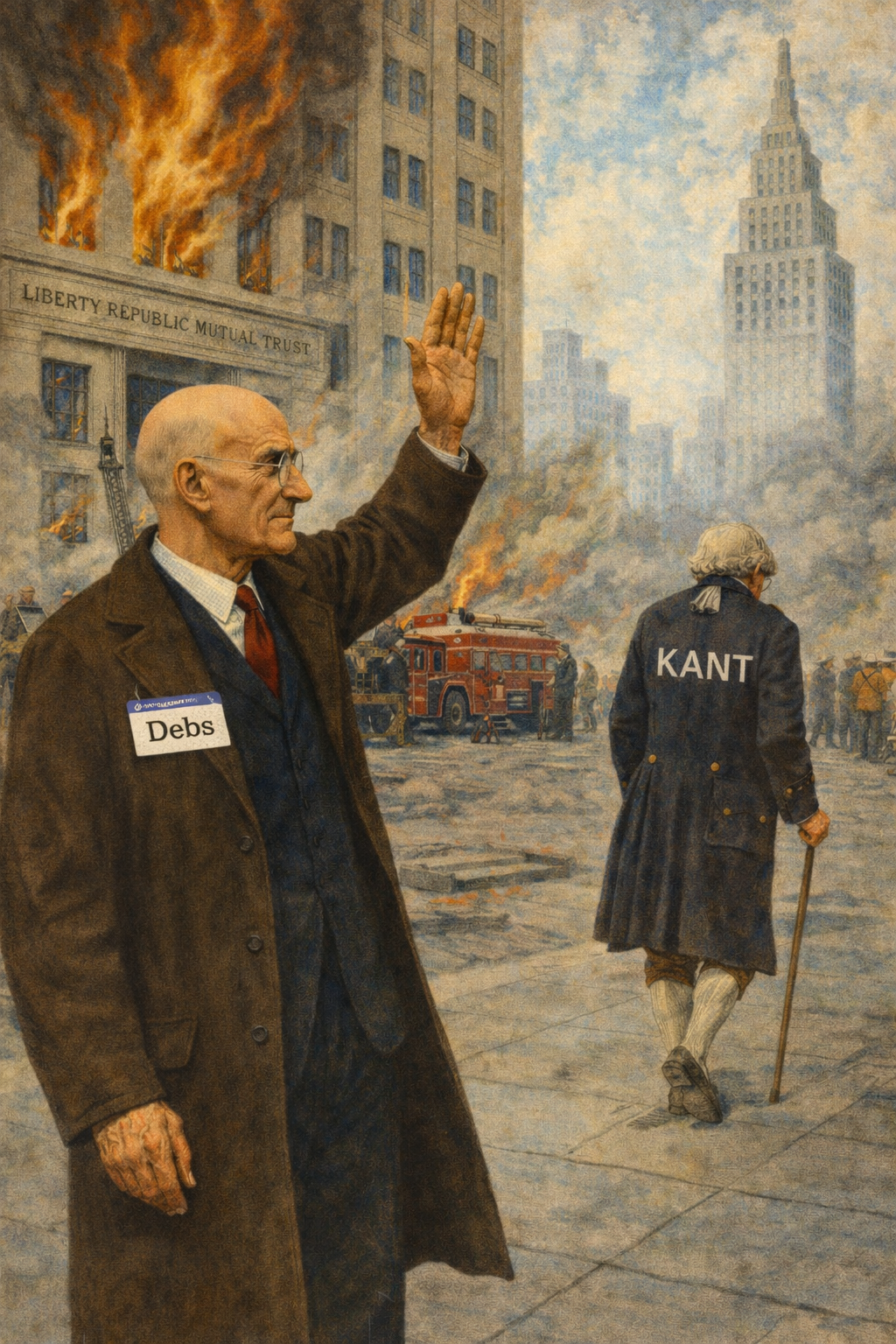
A few months ago, I published an essay, Liberalism’s Double Inheritance and Socialism’s Rescue, arguing that democratic socialism could be understood as the fulfillment or rescue of liberalism’s highest humanist ideals. I wrote it sincerely, and I still stand by much of what it argued: that liberalism’s commitments to dignity, freedom from domination, and human flourishing are historically serious; that democratic socialism (disciplined by anarchist suspicion of authority) is democracy’s ally, not its enemy; and that neoliberalism increasingly courts authoritarian outcomes rather than democratic egalitarian ones.
What I no longer trust is the strategy of justification I used.
As I continued thinking—especially while developing a framework I now call “contestarity” and reengaging my longstanding discomfort with deliberative models of legitimacy—I realized that appeals to liberal inheritance were doing legitimacy work I’m no longer comfortable with. Under late-modern conditions, legitimacy has become too easy for power to claim and too difficult for the governed to withdraw. Rationalized justification often insulates authority rather than constraining it.
I’m reposting a revised version of the essay that preserves its care for liberalism’s humanist aspirations while withdrawing its faith in liberal democracy as a grounding order. Democratic socialism, as I now see it, does not require liberalism’s blessing; it becomes necessary where liberal forms prove structurally unable to secure freedom against entrenched power.
Thinking in public sometimes means revising in public. This is one of those moments. Here is the revised version.
Liberalism matters—not because it can still ground democratic legitimacy, but because its most serious moral commitments help explain why legitimacy has become so fragile.
From its earliest articulations, liberalism spoke in the language of dignity, individuality, and freedom from domination. These aspirations were neither cynical nor trivial. They named real human longings: to live without arbitrary power, to develop one’s capacities, to stand as an equal among equals. But liberalism also sought to secure these aims through institutional arrangements—most centrally, through absolutist conceptions of property and accumulation—that it never fully subjected to democratic control.
The result was not simply a tension within liberalism, but a structural problem that liberalism proved unable to resolve. As economic power expanded and consolidated, the promise of freedom increasingly depended on arrangements that insulated authority from those subject to it. What began as a project of human emancipation gradually hardened into a political order in which legitimacy became procedural, contestation became symbolic, and domination learned to speak the language of necessity.
To understand why democratic socialism has become necessary, it is therefore worth taking liberalism’s humanist ambitions seriously—precisely because doing so reveals the limits of the form that once claimed to realize them.
Liberalism has always carried a complicated inheritance. On the one hand, it articulated a powerful rejection of inherited status and arbitrary rule. On the other, it tethered that rejection to an expansive conception of property—treating accumulation itself as a guarantor of liberty. The result was a political tradition pulled in opposing directions: toward the universalization of freedom, and toward the entrenchment of inequality as a byproduct of supposedly natural rights.
John Locke’s familiar story of the “state of nature” made property appear as natural as breathing. When someone “mixed their labor” with the world, the product became theirs by right. What this metaphor quietly accomplished was the transformation of a claim about activity into a claim about exclusive control. Locke initially gestured toward limits—no one should hoard what would spoil—but those limits dissolved once money entered the picture. Durable exchange removed the moral brake on accumulation. Inequality could grow without bound, while liberty remained rhetorically intact.
This move proved foundational. Property rights came to be treated not merely as one domain of freedom, but as the precondition for freedom itself. Political rights were built atop economic arrangements increasingly insulated from democratic interference. What we now call neoliberalism did not so much abandon this logic as intensify it. By treating financialized accumulation as the highest expression of liberty, neoliberalism stripped liberalism’s property commitments of their remaining restraints and recoded necessity as entitlement. Markets without boundaries and accumulation without limits came to appear not as political choices, but as facts of nature.
Yet liberalism’s moral seriousness repeatedly generated internal resistance to this outcome. John Stuart Mill worried that liberty reduced to non-interference would hollow out the very individuality it claimed to protect. T. H. Green argued that freedom was not mere absence of restraint, but the positive capacity to do and enjoy what is worth doing and enjoying. These thinkers did not reject liberalism’s aspirations; they pushed them further—far enough, in fact, to expose the strain between human flourishing and an order organized around unrestricted accumulation.
John Dewey confronted this strain most directly. Writing in the shadow of industrial consolidation, Dewey recognized that freedom could no longer be secured by formal rights alone. When power concentrates in corporations that organize daily life, democratic habits wither regardless of constitutional form. Dewey did not merely refine liberalism; he showed that democracy was beginning to outrun the institutional structures meant to contain it. Economic power, left outside democratic control, became the effective governor of social possibility.
These internal critics are often invoked as evidence that liberalism can correct itself. But they can also be read differently: as signals that liberalism repeatedly recognized problems it lacked the institutional means to resolve. Each pushed against the absolutism of property and the insulation of economic power, yet none could fully reconcile democratic equality with a political economy structured around private domination.
Later efforts to shore up legitimacy took a different turn. Jürgen Habermas sought to relocate democratic authority in procedures of justification and rational assent, warning that economic and bureaucratic imperatives could hollow out the public sphere. His work represents a sophisticated attempt to repair legitimacy under conditions where its material foundations were already eroding. But procedural justification, however demanding, cannot substitute for effective contestation. Power may be discursively defended and procedurally authorized while remaining structurally unanswerable to those it governs.
What emerges from this history is not a story of betrayal, but of exhaustion. Liberalism’s most serious humanist commitments generated critiques of domination that its own institutional architecture could not sustain. As economic power outpaced democratic control, legitimacy became easier to claim and harder to withdraw. Silence was mistaken for consent; stability for justification.
Democratic socialism arises from this condition not as liberalism’s fulfillment, but as a response to its failure. It does not require liberalism’s blessing. It becomes necessary where freedom has been reduced to property, where democracy has been confined to procedure, and where authority has learned to shield itself behind claims of inevitability. Its core insistence—that those subject to power must retain the real capacity to contest and reshape it—addresses precisely the problem liberalism could name but not resolve.
This is why political democracy without economic democracy proves so fragile. When daily life is organized through relations of subordination, democratic agency erodes regardless of formal rights. Democratic socialism does not promise harmony, nor does it offer a perfected endpoint. What it offers is a refusal: a refusal to treat entrenched power as legitimate merely because it is stable, necessary, or well-managed.
The narrowing of neoliberal imagination—its insistence that no alternatives are feasible—has not preserved freedom. It has hollowed it out, leaving democratic institutions brittle and vulnerable to authoritarian capture. Democratic socialism seeks to break that narrowing not by redeeming liberalism, but by responding to the conditions liberalism could no longer govern.
The question before us, then, is not whether democratic socialism honors liberal democracy’s inheritance. It is whether we are willing to confront the fact that freedom now requires forms of democratic discipline liberalism was structurally unable to supply.
 Back to the Root
Don’t just think it, SAY IT. HERE!