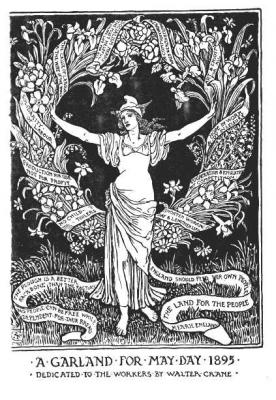
How about if this year we begin to get May Day right.
Some May Day history:
In October 1884, the Federation of Organized Trades and Labor Unions (FOTLU) placed a stake on the landscape of American labor’s struggle for workers’ rights and workplace justice. By the 1880s, the most unifying demand around which all the fractious groups and unions could organize their many-fronted fight was the shared aspiration to win an eight-hour workday.
And so at the October convention in 1884, FOTLU proclaimed that beginning on May 1, 1886, the eight-hour work day would become the law of the land. In 1885, the powerful Knights of Labor declared its solidarity with the fight for the eight-hour workday and that the demand would be supported by strikes, demonstrations, and militant direct action. Many anarchists and radicals thought demand for the eight-hour day was too reformist, claiming that nothing less than the complete overthrow of industrial capitalism should be the aim of the struggle against the combined forces of oligarchic corporations and government. But as conflict heated up with the approach of labor’s announced May 1 deadline, solidarity strengthened and the radicals threw in with the broader movement for the eight-hour day.
In the weeks preceding the planned mass strike on the movement’s deadline date, the Chicago radical anarchist paper The Alarm published incendiary articles supporting the movement. Along with articles on how to make homemade dynamite, The Alarm published an editorial that included this:
Workingmen to Arms! War to the Palace, Peace to the Cottage, and Death to LUXURIOUS IDLENESS. The wage system is the only cause of the World’s misery. It is supported by the rich classes, and to destroy it, they must be either made to work or DIE. One pound of DYNAMITE is better than a bushel of BALLOTS! MAKE YOUR DEMAND FOR EIGHT HOURS with weapons in your hands to meet the capitalistic bloodhounds, police, and militia in proper manner.
The table was thus set for the tragic and glorious Haymarket Uprising of 1886.[1]
A General Exhortation and Harangue
As in the latter 19th century, we live right now in a time when the never-sleeping impulses to oligarchic order, inherent and always present in the assumptions of capitalism and property-liberty ideology, are (re)consolidating the forces of plutocratic power and unilaterally (re)imposing the terms and conditions of our labor, lives, and liberties as well as the very boundary parameters of our human social agency.
Meanwhile, we all forget what Labor Day commemorates–it’s date deliberately moved by law from the anniversary of the Haymarket Uprising and conveniently placed on an obscure long-weekend-excuse Monday at summer’s end–strategically banished from the date upon which the entire rest of the Western world honors workers. May Day is the workers’ holiday marking the anniversary of America’s pivotal moment in labor history, the event that set the world afire: Haymarket. The Battle of West Randolph Street, Chicago. May 1, 1886.
Our children would hardly know it, but we are the descendants of homely heroes and workaday champions, of anarchists and labor activists who fought for justice, dignity, and a bit of human grace for the working class.
We are the generations Joe Hill and Mother Mary Jones and labor hero, Frederick Douglass (that’s right, go look up the Colored National Labor Union, established in 1869), [2] and, as important–though their names are lost to history, the thousand of strikers, organizers, random drifting day laborers, misfit malcontents, the shabby martyrs and quotidian saints of Hay Market, Lawrence, Ludlow, Homestead, Lynn, Troy, Martinsburg, Seattle, Cripple Creek.
And more: Every American alive is the inheritor of the vast estate left by tens and hundreds of thousands whose names were barely ever known at all who were maimed, starved, scarred and killed on their feet, working their tools and dies and looms and pickaxes and crop rows and furnaces and blades and plowshares and on and on, creating stunning wealth, building the foundation for dizzying heights of academic enterprise and expressive arts, the breathtaking advance of science and medicine, as well as the new technologies of mastery and bureaucratic control that would insure that they, the workers—the wealth creators, would never be allowed to dis-alienate from the astonishing and abundant products of their own labor nor share but a fractional nanoportion of the vastness of the wealth their toil alone created.
But, as long and bitter as their days were, they spent their meager hours before succumbing to sleep organizing resistance to the bestial life fashioned for them and their children by the self-anointed proprietors of the Earth’s bounty and the products of other people’s labor—the social squatters and parasites who would now have themselves called “job creators.” Generations of American workers creating the prosperity of nations by day and struggling for worldwide justice by night.
This is American History as proud and exceptional as it gets. This is the history of the struggle for workplace dignity and the rights of the proletariat as American as guns and riveted blue jeans. It is no exaggeration to say that America is the world’s nursery of Socialist dreams; only the successful suppression of this history of America’s powerful place in labor history makes such a perspective seem fanciful.[3]
This is the real exceptionalism which all of America’s various power classes have agreed to deny—the substantive exeptionalism that has defined us since winning our separate and equal station among the nations: That beacon-light which America once shined brightest and most hopeful for all places on earth embroiled in the historic worldwide struggle for the rights of workers; Our national heritage as the vanguard of workers battling to secure the humanity, dignity, and agency of those in every corner of the Earth whose toils build what prosperity this world knows, the anonymous class who labor while their self-appointed masters wring “their bread from the sweat of other men’s faces.” [4]
Our ragtag American founding heroes of International Labor heroically built a movement and constructed a history that we, carelessly and cravenly, have allowed to become a largely suppressed and thoroughly sanitized set of shadows from the footlights of the minstrel show version of our American past , a shadow play we amnesiacally submit to as we are ceaselessly fed the bovine ruminations of history- scrubbers: the David McCullochs and Steven Ambroses, chipper and saccharine Ken Burns, wooly and well-meaning Arthur Schlessinger. All the commercialized purveyors of airbrushed portraiture honoring tyrants and thieves (…the founding fathers tireless efforts to…); singing smorzando encomiums to enemies of the people.
This Vapid Mythtorian Chorus sings us a well-rehearsed, palliative yet bracing, pianoforte operatic, bourgeois misnarration of “our” courageous will to march on, against the slings and arrows of naysayers and skeptics, as a good and classless nonsociety of individual strivers headed toward our God-guaranteed place in the shining city on the hill of human history under the enlightened leadership of the crowned heads of the Houses of Astor, Mellon, Rockefeller, the Council of Titans at Bretton Woods, WTO, ISDS, Koch and Coke, not mention Siemans Shell Walmart & Sinopec (LLC).
And then, at intermission, so to speak, we are treated to polite and tepid tributes to labor heroes, brief anodyne accounts of martyrs to justice (as well, by the way, see obscure footnote, see hyphenated-history side panel).
A Peroration
Perhaps this May Day we will recall that other May Day, Haymarket, 1886. The origin of that worldshaping collective action was the simple struggle for the eight hour workday. The strikers’ homely aim was to carve out some small daily space for their humanity—as parents, as spouses, as lovers, as drunkards and dreamers, as singers and sinners, as religious believers, barbershop philosophers, atheiststic parkbench belly scratchers, flowerbox botanists. Just a one-third slice of day between each exhausted night’s eight hours sleep and each workday’s eight hours labor to use as such persons will. As men and women; as more than merely resources for production; more than a stubborn collective cost against revenue, a drag on capitalist profit.
As worker-protesters gathered on the soon to be hallowed ground of West Randolph Street, the labor poet-activists of the eight-hour workday movement handed out the simple words to the protest anthem:
We want to feel the sunshine
We want to smell the flowers;
We’re sure God has willed it.
And we mean to have eight hours.
We’re summoning our forces from
shipyard, shop, and mill;
Eight hours for work, eight hours for rest
Eight hours for what we will.
A Call to Action: Do Something!
This year take May 1st off. Use the day to read some labor history. Post messages of solidarity and support on the dozens of Facebook pages devoted to workers’ groups. Write your elected representatives demanding action on raising the minimum wage. Send hate messages to National Right to Work. Come up with ideas on how to stimulate revival of the American union organization, share your ideas on social media.
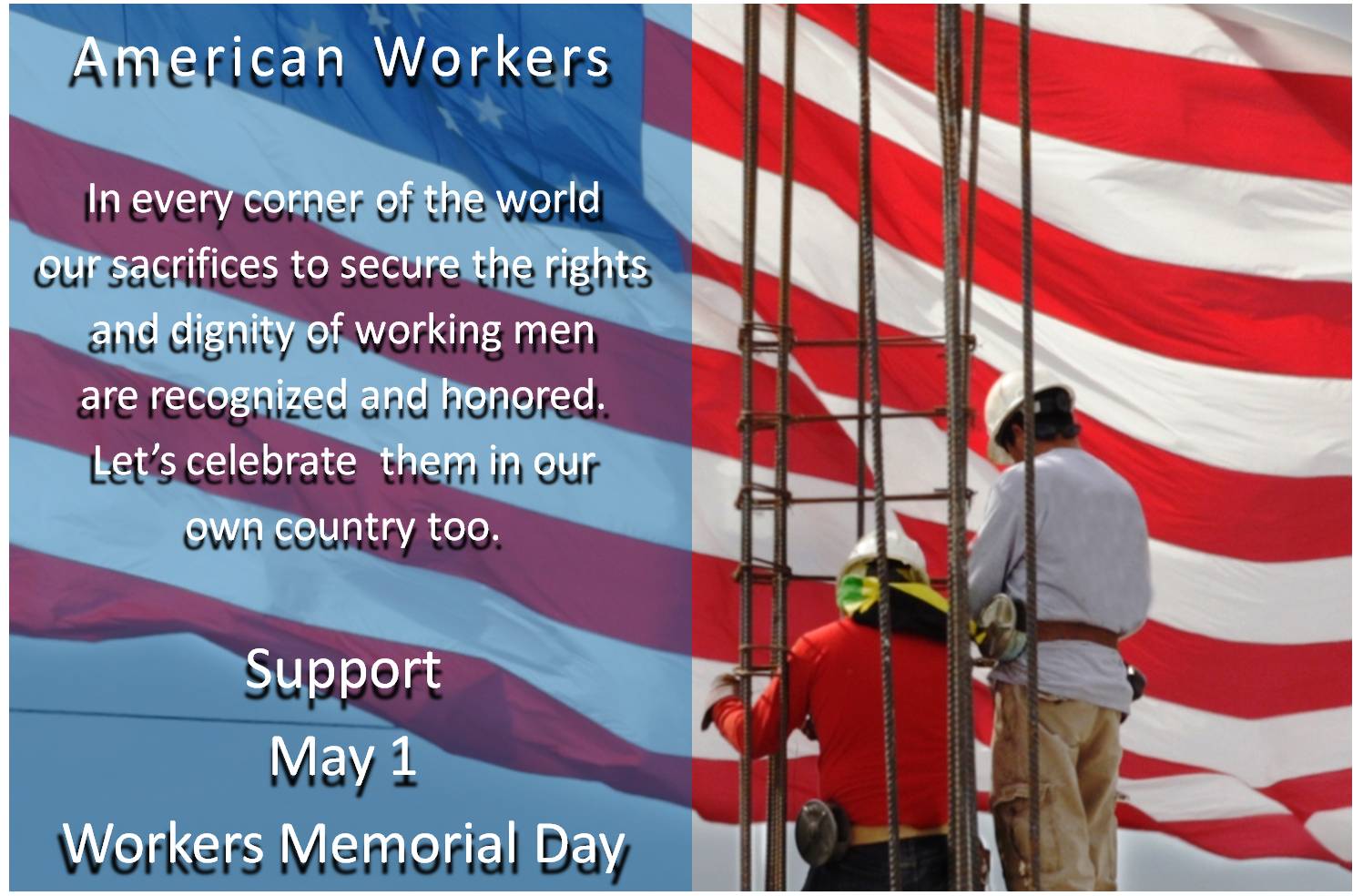 SIGN THE PETITION TO MAKE MAY 1 ANNUAL AMERICAN WORKERS MEMORIAL DAY!
[1] For anyone unfamiliar with the story of the Haymarket Uprising a couple of places to get started are linked HERE and HERE.
[2] Colored National Labor Union, established in 1869.
[3] A quarter century before a dyspeptic German expat vagrant would, from whatever open seat he could find in the British Museum’s Reading Room, scratch out his first article for America’s most widely circulated journal, Horace Greeley’s New York Tribune (August 21, 1851) and nearly half a century before that same penniless savant of social theory, Karl Marx, would be tossed out of his own Workingmen’s Association by a faction of anarchists (1872), factory workers in Philadelphia had already established the world’s first Workingmen’s Party (1827). America: The World’s Nursery of Socialist Dreams.
[4] Go get a timeline of Labor History and set it alongside a timeline of the lead up to, and aftermath of, the Civil War and see if you can figure out how this kind of language might have occurred in the mind of the Illinoisan President’s s he penned his Second Inaugural Address. And perhaps why the business base of “moderates” in the Republican Party might rushed to shutdown the Radical Republican’s Reconstruction plans for land reform and the seizing of plantation property to turn them over to collectives of the freedmen.


 Back to the Root