It couldn’t have been easy for a 12 year-old poor girl from North Carolina hill country to risk all her unlikely dreams by refusing to play at her first formal concert recital. But she did. Thought she had to I suppose.
Even though Eunice Waymon was a prodigy—started playing piano at three, for a pair of struggling, working class parents from Tryon to find a way to get Eunice a genuine concert recital, there had to be a bunch of sacrifices and a lot of invested hope, not just from Eunice and her parents, but also from whoever pitched in to help this gifted kid land such a big opportunity. The Waymon’s couldn’t have done it alone. They were simple poor folks without connections to sophisticated people. And they were black. And it was 1945.
So Eunice must have known how much was riding on doing everything just so for this recital. But when Eunice saw that her parents had been removed from the front row of the concert hall and shown to the seats for coloreds at the rear, apparently her sense of right overcame what must have been an outsize fear for a child of 12—to defy authority, white authority; make a fuss, act uppity; risk everything she and her parents—a housemaid and a handyman—had sacrificed for this one child of seven to get to this point. A child risking an opportunity big as her whole life and more, but fragile as a rare ice coating on a winter pond in the North Carolina piedmont.
But 12 year-old Eunice from Tryon refused to play a note until her parents were returned to their rightful front row seats.
Apparently the showcase recital went well because Eunice was on her way after that. A fund was created to help Eunice attend school and study her instrument. At 17 she got the chance to enter the elite and highly competitive Curtis Institute of Music in Philadelphia.
Though it seems she had done everything needed to earn admission by the school’s official standards, she was rejected. Now a young woman who’d seen some things, Eunice thought the rejection was another instance of racist discrimination and, though she may or may not have been correct about the Curtis Institute’s rejection, the important point is Eunice believed it—an important point because racial injustice and battling against it would shape the rest of her career and her commitments within and outside the music and entertainment field she was to inhabit for the next half-century.
Eventually Eunice, who eventually got into Julliard to receive the classical training she sought, would give up her aspirations of a career as a classical pianist when limited funds compelled her to begin playing jazz and blues in Atlantic City. She changed her birth name for one more suited for the entertainment industry and became Nina Simone.
But though she gave up on classical piano and traded in her name, she did not give up either her fierce sense of racial justice or her will (some said diva attitude) to raise her voice and make trouble when she thought trouble was called for.
Color
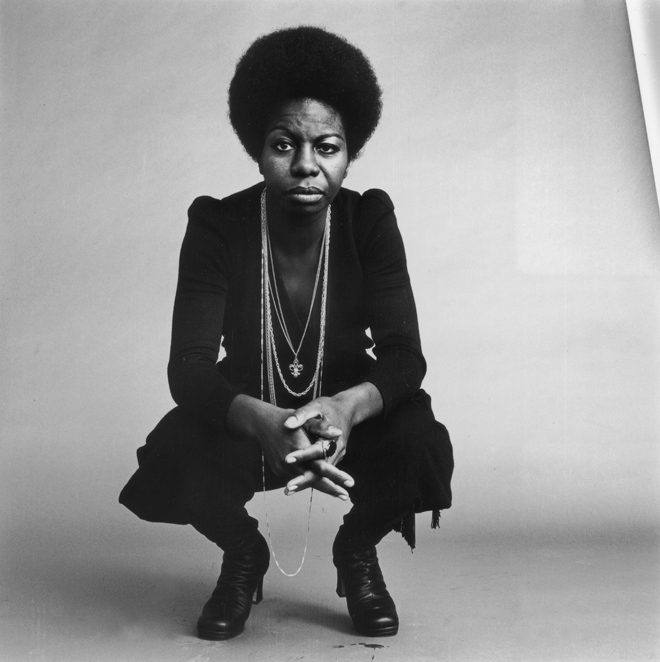
Everyone who knows the basics about Nina Simone already knows of her commitment to the concerns of racism, a commitment demonstrated both through her songs and through her role in the Civil Rights movement. But one matter Simone thought called for her kind of trouble went beyond the rough edged concerns of racism to the more delicate issue of colorism. As a dark-skinned, coarse haired, broad nosed, thick-lipped woman of color, Simone was well aware of Americans’ (of both races) cultural preference for—and privileging of—the more Anglo-European coloring and features of “passable” black women. How do we know she was aware of it? Because she was Nina Simone: when something bothered her, she made trouble about it. She spoke about it, acted on it, and sang about it.
In all the popular art forms, women of her complexion and features were (and remain) at a career disadvantage relative to female artists with “prettier” (read: euronormative) faces and body types. Simone could be forgiven for thinking this state of affairs politically, economically, and culturally unacceptable. Or just simply wrong. As wrong in its own way as moving her parents to the negro seats during their daughter’s piano recital.
Culture
Of course, today’s release of wordy words is inspired by the casting of Zoe Saldana for the upcoming biopic about Nina Simone. It is inspired by that but it’s really not about that.

It’s not really about whether Saldana should have taken the part (please, she’s an actress), or if Saldana is not black enough or black at all (c’mon), or if anyone should boycott this movie (I won’t go see it, but that’s because (1) the movie will apparently contain none of Simone’s music since the company was unable to obtain the rights, so (2) the movie will rely for its main dramatic interest on a romantic relationship that never happened; (3) I do not have any reason to believe that its writer-director has the capacity to make a watchable movie about someone whose music and being I am crazy about and so (4) I’d rather watch Nina Simone videos until someone not interested in a major-release hit decides to tell a story about her in film. And anyway, (5) biopics generally suck.)
It’s about something far less serious (but far more meaningful) than these concerns. It’s about the economics and politics of culture and entertainment. It’s about stupidly missing an opportunity to honor Nina Simone the influential artist even while profiting from making a movie about her. And it’s really pretty simple. No heavy, Frankfurt School, Critical Theory needed.
Casting Zoe Saldana[1] would seem to be either a tastelessly ironic joke by writer-director Cynthia Mort, or a complete failure to do even minimal research about the public and interior life of the character Mort’s movie is putatively about. Either way…
But maybe I’m being unnecessarily concerned about the director’s plan for Nina. IMDb offers this storyline summary: “The story of the late jazz musician and classical pianist Nina Simone including her rise to fame and relationship with her manager Clifton Henderson.”
Good. I sure hope for Mort’s sake it spends so much time on the entertainer Nina’s rise to fame and her relationship with Cliff Henderson (who in real life was, by the way, entirely out as a gay man) that no time is left to explore the work and mind of Nina Simone the woman and artist, because it would be painful to watch an audience try to keep a straight face while watching Saldana speak lines expressing Simone’s oft stated thoughts about the entertainment industry’s deplorable backhanding of talented dark-skinned black women.
Seriously. With Saldana in the role, they should really just skip this whole part of Simone’s life and work and add an exclamation mark to the title: Nina!
That would be far better than embarrassing everyone involved, especially the audience, with scenes involving Saldana talking, as Simone did, about her wooly hair and broad, flat nose. (We can always hope that Saldana’s ability to speak any lines at all will be inhibited by the ridiculous buck teeth they have outfitted her with in a pitiful attempt to simulate Simone’s enticing overbite that flashed whenever she graced an audience with a rare but genuine smile; typically after a brilliantly improvised riff from her band or a smart improvised line of her own.)
Complexity
Don’t overthink this. Don’t get caught up in double paradoxes of ‘post racial’ reasoning (seriously? ) or the literal ‘shades of meaning’ about color.
Make it simple: Imagine Simone had not been a singer but an actress who’d spent her whole career pointing out Hollywood’s pernicious colorism. Whether we though that character’s views were right or wrong, well-reasoned or obsessive, fair or not, we would not be engaging in discussion about whether or not Saldana (or Jada Pinkett Smith or Jessica Alba or Christina Milian or…) should be getting made up to play the role. It would be absurd. No director would have even sought a reading or casting interview with Saldana.[2]
But that obviousness, the obvious absurdity of casting any actress like Saldana is somehow blurred by the fact that Simone’s critique came from a singer instead of an actress (a strange blindspot given Hollywood’s usual subtlety on matters of meaning and cultural interpretation…)
It could be argued that for writer-director Mort and, more importantly, the film’s financial backers, colorism is beside the point; simple capitalism dictates that a name-brand actress like Saldana is needed to make the deal fly and generate box office receipts. Or more generously, one could argue that the filmmaker wants a large audience to watch a movie about Nina Simone.
Okay. Go ahead. Make either point. So now you have arrived at my point. The pool of dark-skinned black actresses with Saldana’s name recognition and Hollywood buzz is shallow. That is exactly what Nina Simone made trouble about. And that fact is exactly why people are making trouble about this movie.
See?
Sometimes seeing the complexity of an issue blinds us to the obvious.
And This
Watch Nina Simone perform her song Four Women and then ask yourself a few questions:What kind of film would do proper justice to this woman’s remarkable work and artistic gift? Do you trust the woman who wrote The Brave One and the actress who played Neytiri (or any role in Avatar for that matter) to make that kind of film? Nina Simone was the very essence of countercultural pride and subversion; are these the people to celebrate Nina Simone’s celebration of counterculture?
Next blog: Why Mel Gibson would be a poor choice to play John Brown, Elie Wiesel, or a human.
 [1] Last seen in a prosthetically engineered face and colorizing movie makeup for Avatar in her role as a euronormatively beautiful female creature from another planet (Hollywood long ago having determined that even our spacecritters have to fit conventional criteria of attractiveness, especially when cast alongside white leading men with transspecies sexual proclivities…). Perhaps Saldana is seeking to carve out a niche as the actress most willing to alter her face and color.
[2] Unless the director made that choice as a deliberate, challenging point of meta-commentary. I think we can dismiss any notion that Cynthia Mort (whose ‘writing’ and/or production ‘skills’ are behind the grotesque misuse of Jodie Foster’s talent for the preposterously dullwittted revengeporn flick, The Brave One, six episodes of the shitcom Rosanne, a dozen or so episodes of the precious and precocious Will [ampersand] Grace, and little else) has that much in mind or the chops to carry it off if she did…
Related articles
- Music: Newswire: Good lord, these photos of Zoe Saldana as Nina Simone are terrible (avclub.com)
- The Gentrification of Nina Simone: Stop This Movie (slog.thestranger.com)
 Back to the Root
One response to “On Color, Culture, and ‘Complexity’”
[…] On Color, Culture, and ‘Complexity’ (back2theroot.com) […]
LikeLike