Just last week I found myself in yet another numbing discussion with yet another oh-so-sophisticated young ‘progressive’ who felt compelled to share his dismissive annoyance with the Occupy movement for its (you guessed it!) lack of identifiable leaders and (supposed) absence of coherent aims.
Of course, Young Progressive expressed a shared frustration with corporate excess and the political system’s continued preference for tax cuts for the wealthy and protection from meaningful regulation for corporations, but…
well…
…the Occupiers are just so…unfocused and…well…naive about how politics really works (the liberal’s barely concealed version of ‘but they’re dirty and they’re not at work everyday like I am…’)
Now, it’s true I’ve expressed my own concerns about various aspects of Occupy methods, but I have tried to avoid criticisms that ignore both the movement’s agility and the fact that it is now little more than twelve weeks old. Yet in round after round of discussions with friends and colleagues like Young Progressive (let’s call him ‘Nathaniel‘–as in please-don’t-call-me-Nate…) I have found that complaints about Occupy from its supposed sympathizers are little more informed or tolerant than those of its acknowledged opponents.
I’ve repeatedly slogged through these discussions of Occupy’s alleged lack of ‘seriousness’ (a ‘critique’ which always seems like a packaged set of impressions gleaned from media accounts and criticisms rather than honest objections arising from original, first-hand observations) without much success in expressing the novelty of the moment Occupy occupies and how its reluctance to appoint official leader-spokespersons or reduce its impulse to protest to a short list of demands or policy proposals precisely fits–for the time being–this novel moment. So, maybe it’s time to call upon more articulate and seasoned sources to make the case for Occupy’s current approach to social revolution…
So, Nathaniel…
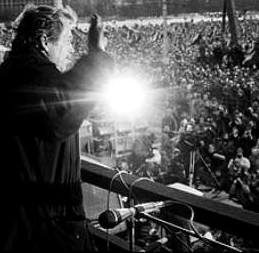
Today, the death of the poet-activist of Czechoslovakia, Václav Havel, recalls for all of us not only the creativity and brilliance of the Velvet Revolution but also the creativity, brilliance and patience involved in preparing its social foundations. Let this day’s reflections on Vaclav Havel remind us of the imperatives involved when the people must resist ‘impersonal power…with the only thing at their disposal, their own humanity‘.
Struggling in post-Prague Spring Czechoslovakia to protect the flame of human resistance from the impersonal forces of bureaucratic socialism, in 1977 Havel (along with Jan Patočka, Zdeněk Mlynář, Jiří Hájek, and Pavel Kohout) organized Charter 77 in protest against the Czech government’s increasing repression of dissident expression. Here is how Charter 77 described itself:
Charter 77 is a loose, informal and open association of people of various shades of opinion, faiths and professions united by the will to strive individually and collectively for the respecting of civic and human rights in our own country and throughout the world–rights…which are comprehensively laid down in the UN Universal Charter of Human Rights.
Charter 77 springs from a background of friendship and solidarity among people who share our concern for those ideals that have inspired, and continue to inspire, their lives and their work.
Charter 77 is not an organization; it has no rules, permanent bodies or formal membership. It embraces everyone who agrees with its ideas and participates in its work. It does not form the basis for any oppositional political activity. Like many similar citizen initiatives in various countries, West and East, it seeks to promote the general public interest.
It does not aim, then, to set out its own platform of political or social reform or change, but within its own field of impact to…document such grievances and suggest remedies, to make proposals of a more general character calculated to reinforce such rights and machinery for protecting them, to act as an intermediary in situations of conflict which may lead to violations of rights, and so forth.
In 1986, Havel wrote about his notion of ‘anti-political politics’ and its indispensability as a mode of resistance for those struggling ‘at the very ramparts of dehumanized power’ (by which he meant within the Soviet Bloc, but which we can well apply to our current experience within the ambit of the totalitarian capitalist imperium):
…’anti-political politics’, is possible and can be effective, even though by its very nature it cannot calculate its effect beforehand. That effect, to be sure, is of a wholly different nature from what the West considers political success. It is hidden, indirect, long term and hard to measure; often it exists only in the invisible realm of social consciousness, conscience and subconsciousness and it can be almost impossible to determine what value it assumed therein and to what extent, if any, it contributes to shaping social development…It is becoming evident that even in today’s world, and especially on this exposed rampart where the wind blows most sharply, it is possible to oppose personal experience and the natural world to the ‘innocent’ power and to unmask its guilt…It is becoming evident that truth and morality can provide a new starting point for politics and can, even today, have an undeniable political power…It is becoming evident that politics by no means need remain the affair of professionals and that one simple electrician with his heart in the right place, honouring something that transcends him and free of fear, can influence the history of his nation.
Yes, ‘anti-political politics’ is possible. Politics ‘from below’. Politics of man, not of the apparatus. Politics growing from the heart, not from a thesis. It is not an accident that this hopeful experience has to be lived just here, on this grim battlement. Under the ‘rule of everydayness’ we have to descend to the very bottom of a well before we can see the stars.
When Jan Patocka wrote about Charter 77, he used the term ‘solidarity of the shaken’. He was thinking of those who dared resist impersonal power and to confront it with the only thing at their disposal, their own humanity.
Does not the perspective of a better future depend on something like an international community of the shaken which, ignoring state boundaries, political systems, and power blocs, standing outside the high game of traditional politics, aspiring to no titles and appointments, will seek to make a real political force out of a phenomenon so ridiculed by the technicians of power—the phenomenon of human conscience?
~Václav Havel, Living in Truth, from Section V of the essay “Politics and conscience“,1984 (my emphasis)
Twelve years would pass after the birth of Charter 77 before the Velvet Revolution would unfold and propel the anti-political political activist to the presidency of a new Czech Republic.
Okay, I know some wannabe smartypants rushes to point out that my very reference to Havel as an authority on social revolution actually demonstrates the reason Occupy needs a leader-spokesperson (put your hand down Nathaniel, we all know you’re here and we know how strategically savvy you are given your vast political experience as a legislative correspondent on the Hill and all…), but remember, in the nine years between the suppression of the Prague Spring uprising and Charter 77, neither Havel nor anyone else would have counted as a dissident leader, nor was there anything like a coherent ‘movement’ to be leader of; that was Havel’s point. Occupy is barely into the 12th week of a social movement that may be 12 years on before it takes real shape as a political force challenging the core arrangement and assumptions of status quo power relations.
No stomach for a generational revolution? Go join the teaparty; that’s a well-funded group with a ready-made agenda and a downhill ‘struggle’ against…well, I’m not sure what they actually have any real beef about, but they sure have very well-identified leaders (like Michele Bachmann, Dick Armey, and Jim DeMint), and they’re real well organized! Chances are good they’ll get most of their preferred social arrangements in place within the next…wait, they already have most of their preferred social agenda in place. I guess the critics of Occupy are right!
So, now with all this in mind, GO READ THIS LINK!
Related articles
- ‘Velvet Revolution’ leader Vaclav Havel dead at 75 (ctv.ca)
- Vaclav Havel Dies: Former Czech President Dead At 75 (huffingtonpost.com)
- Vaclav Havel, former Czech president, dies aged 75 (guardian.co.uk)
 Back to the Root
One response to “Václav Havel and the Spirit of ’77: Descending to the very bottom of a well before we can see the stars.”
[…] Václav Havel and the Spirit of ’77 Share this:TwitterFacebookPrintMoreTumblrDiggEmailLike this:LikeBe the first to like this post. Communismcool heroesCzech RepublicCzechoslovakiaEastern EuropenewsnonviolenceVáclav HavelVelvet Revolution ← Previous post Next post → […]
LikeLike